Wednesday, 19 September 2012

September 19, Young and Old

Angela writes:

A wooden box with rows of bolts on the one side, neatly cut hollow circles on the other. I was to unscrew the bolts out of their nut and screw them again on the opposite side. This, with my left, weaker hand. A deck of cards that I was to shuffle with my left hand again. Pens ordered in a row, which I had to pick one by one with two fingers and replace at the end of the row, in a repetitive semicircular motion. These simple frames have all the appearance of a dream made of disjointed scenes, yet they belong to the training towards recovery I undergo once a week. As you can tell, keyboard exercises are the least surrealist of the propositions offered to me.

For the last few evenings we have watched a couple of documentaries about the life of two silent monastic orders. The Ordre des Chartreux, in the French Alps, and the Discalced Order of Carmelites, in London. The monks in the first, the nuns in the second, dedicate their lives to prayer and contemplation. I had wanted for a long time to know something about life lived in silence, silence almost absolute, except for assigned times when the secluded are allowed to engage in conversation among themselves.

What I found most astonishing is the fact that the more difficult – physically difficult – tasks like gardening (in the Alps it begins with snow still high on the ground) and cooking, sewing clothes, shaving, laundry, all in the service of the community, are accomplished by the older of the brothers and sisters. And by “older” I mean quite old, considering that these groups, small in numbers already, have a precious few members under forty years of age.

It was the prioress of the Carmelites who helped me understand why. She tells the story of her own entering into faith, which took about eighteen years after her entering the order. She alluded to how, busy with work, with the daily chores, she had no time to face herself and therefore fell into deep spiritual drifting, doubt, maybe the despair of not being sure of anything any longer. Such a state, the melancholy or acedia of the cloistered, cannot be cured but by study, self-examination and prayer. In other words, the young – and again, by young we understand here the able bodied at the stronger pole of the spectrum – are supposed to work much more towards reaching that state of self-understanding, than to contribute, through the execution of tasks, to the well-being of the community. As time goes by, and one is better advanced into accepting one’s condition and place, one can begin to give more to those with whom she shares her life and beliefs.

The gardener and cook of the Chartreux was so old, his body so feeble, that he had to lean on the spade with which he was digging his garden in order to move from place to place. The tailor’s neck, so bent as to resemble a flamingo’s. His vertebrae a crown of knots under the hand of the brother patiently rubbing an ointment onto the old man’s shoulders and back.

Nevertheless, the old and very old have now reached a place where the work of the spirit is mostly done. The reading, the praying, the contemplation and learning, are more urgently a task for the young. And in a reversal of the order of things we are accustomed to, the more difficult, more exigent – including bodily – of tasks, are deemed not to be the physical ones. Not that there is not a part of physicality in prayer and learning, of course there is. But it remains that all of the able body’s energies are employed towards the sustenance of a yet doubtful soul. As soon as that part of learning is achieved, or achieved mostly, the body, now feeble and fatigued, is ready to put itself into the service of the necessities of life.

god's ribs
It is a marvelous use these orders make, of the old. So long as they can move. While we, seculars, wait for later to possibly address the needs of the soul, and put all our young energies into the service of the body, youthful appearance including. And keep postponing the day when we should look at the nakedness of our flamingo spine.

All the way hoping, that such a day should never come to us.

Friday, 14 September 2012

September 14, Reading from the Book of Nature

Angela writes:

We live in the midst of a colony of chipmunks. At this time of the year they gather acorns for the winter. This year their task is accomplished with more fervor than before. Every morning we open the door to the outside only to step into a pile of leafy branches ripped away by careless riders avid to acquire as many oak nuts as critterly possible. The looting accompanied by screams and squabbling. I hear this is a new habit; the old generations used to be known for the delicate method by which they separated the nut out of its shell.

It might be, I hear, sign of the terror that the coming of a very harsh winter instills in those who have not set aside enough for the dark season.

This is quite how I feel while writing here. Writing used to be about careful planning and only opening the shell of promising ideas. The rest, passion, imagination, fear, was left for later. Yet since I do not know what winter holds in store for me, I will try to set aside as many words as I can, before loosing grasp of my branches.

On the other hand, what a marvelous experience, that of the hibernation of the reading and writing animal we have become. This is the second time I am tested by such an interruption of purpose. The first time it happened 33 years ago.

Neither the year before, nor the year after my coming to Canada, did I read any book, or did I write a line outside the aching letters addressed to my mother. As soon as I set foot in this country, I thought the best way to learn its language would be to read more books in English. Such had been the case when I was a student back home. And because my favorite novels in those days were Latin-American, I bought a pile of translations of those into English. I thought you learned a language by reading books you loved. As it turned out, I became immediately impatient, if not bored. Those novels could teach me nothing of the new life I was exposed to, like a naked body exposed to the burning sun, in need of cover. What they did was to incessantly remind me of the life I had left behind. Ordinary, tacky fashion magazines, tabloids, the Calgary Sun, taught me more, more shockingly and efficiently, and so did all those hours of sitting, scared and befuddled, in front of the incomprehensible television set.

Once a year or so of such learning went by, I was ready to go back to school.

I ignore what kind of school I am attending now. I cannot read but I do not miss my readings, those which have been second nature for me for so long will not teach me what I need to know under my new circumstances. Just as I do not find succor in your guide to gentle, non-toxic healing. The other day, listening to the French CBC as I do lately, I heard a French philosopher extol the advantages of “reading from the book of nature”. Having published some fifty books or so, he discovered that nature has more to teach us than the printed word. In order to make that point, he performs in a play, alongside twenty thousand bees also called to bear the heat of the stage.

one way of reading from that book


But who has the time, I ask, to "read from the book of nature”? Ill parents lying on hospital beds and waiting for another morning, children like Marius who wants to know where we go to from here and weather we come back again after, patients like myself who, while waiting for another test, jealously watch the multitude of critters who carry on preparing for winter, blissfully ignorant of imaging techniques. And people like our sister in law Robyn, whose job it is to bring that which used to be called nature back to the city; and who, incidentally, also keeps bees. But be warned: whatever we get to glimpse out of this book of nature under the form of some understanding becomes, even for those who have got hold of it, one more impenetrable secret to preserve.

Wednesday, 12 September 2012

September 12, Speaking in Tongues

Angela writes:

Not long ago our niece Grace, who was visiting with her family, asked me a question many an adult would be advised to ask, including of themselves. She said that Madame had instructed her pupils not to translate from English when they were practicing their French. Yet, after a few days in our house, Grace wondered how this rule of language was working in my case? Was Madame right? Did I ever translate? And if so, from what language?

You will agree that such a question is not easy to answer, to say the least. I was here before a very thoughtful child, and I better chose my words wisely. I could hardly say I was not translating, since that would be close to impossible, especially when – as she had rightfully observed – all these other fragments of language keep wandering through my brain uninvited, blind and rueful. If I am to answer truthfully, I will have to observe, like an outsider, my practice.

Our morning walks – mine and Rocky’s – on the trail, are the place to start. I have called this old railroad trail that used to cross Canada from shore to shore, now reduced to a path for hunters in search of game atop their ATVs, many things since we moved here. Right now I call it the trail of confession and promise. On the way out, eastward, I discuss those things that I consider reprehensible in my recent behavior. They usually concern the manner in which I give in to my fear. This illness has weakened my resolve and brought to their creaky knees all those years of philosophical reading, writing and teaching. Does philosophy teach us how to die? Theoretically yes, maybe. Practically, very little. Between Montaigne, who thinks it does, and Derrida, who only a few years ago found out, not unlike myself, that it does not, I am torn and astray. Theory bends its proud neck under the threat of crossing from this to the other world. One is left with a few grains of dust in one’s hand, the grains of foolish knowledge.

On the way back, westwards, I turn to the Saints. To them – that is, to the ones with whom I have a relationship – I make a promise. We have discussed these weaknesses many times, and my promises are renewed anew without much remorse. They may or may not be kept; the important thing is to keep working on that construction of resolve. Which in the end may prove to be helpful.

Here I come finally to my topic. A person in my condition, most often in the company of my dog, and, while on the trail, happening upon beaver, or falling under the diligent gaze of a good number of cows, needs to speak aloud to keep that priceless gift of speech alive. What language do you think I use, when I speak alone, that is, with my dog, the beaver, the cows, and my Saints? Mostly French. Sometimes Romanian, when the matter is grave beyond redemption, and the skies really gray. But there will be only a few, well-weighed words in that language.

French because I miss speaking and hearing French, it is a fact. Yet I figure, once in the world beyond, languages must loose their specificity and become interchangeable. They must sound like Fredo Viola’s Sad Song. Everybody should understand everybody else without effort, regardless of the language they speak, and what is left of that old specificity is the affective color of that language in tatters still used. Nowadays, because I paint, and because every single painting is a submission to my first teacher of the art, my own French Madame, I take the liberty to speak French to my Saints while promising to strengthen my resolve. They certainly get the color of my language, which is the color of affection, foolish knowledge, bonheur and still time at once.

Of course I did not tell Grace this story quite in so many words. To her, for now, I said the choice of language and the manner of speech had to do with whom one spoke to, what one had just read, or who had visited her in her dreams. Although quite often nowadays, the first thing I ask Colin when we wake up in the morning is:

“Cit e ceasul?”

September 11, Physiotherapy

Angela writes:

I have a new physiotherapist. My old one, the one who had cured my broken ankle and tried to help my broken back, has left for the more alluring skies of BC. I loved her because she had been a gymnast in her youth. All these years later, and she is about my age, her body the bearer of the grace branded by that superwoman-superchild sport.

After her departure I thought I would not go back to the town of Campbellford. I would not continue my therapy there. I did not want this separation to weigh upon the already exhausting balance of good byes I carry around. Yet as soon as the month of September sent everybody back to work, I felt I’d better take up again at least this one fragile routine and pretend I was going back to some sort of work myself.

The new physiotherapist looks nothing like the job would presuppose. On the other hand, her name is Kathy. There have been so many Kathy and Catherine in my life. Some are still with me, some are not, and some are tenuously in-between. I decided I should give this Kathy a chance if only in the name, the melancholy name of those older associations.

She turned out to be more interested in the workings of my fingers than of my arms. I am in therapy because my arms have been weakened by the tumor. My fingers have been even more affected, of course. That is why I have not written anything since last October, when I did a paper, my last paper, for my friend Calin. But until now, knowing the damage to the fingers to be irreversible, therapy has only been concerned with strengthening my arms. And some progress occurred.

Nevertheless, the new Kathy came up with a new idea, which I confess took me by surprise. That I should work on my fingers.

She is telling me to pull a facecloth between my two weakest fingers, the index and the thumb, held tight; or to endlessly clip laundry pins on a rod; or, better yet, to sit in front of the computer and practice typing, for a few minutes every day.
I look at her in disbelief. I find typing difficult. This is why, last year, once out of the hospital, I got an iPad. In order to write on an iPad you only need to use one finger or two.

That is precisely why, she comes back, you should use the computer keyboard, and just type away, numbers, random phrases as they come to your mind, whatever you hear, if you do not know what to.

A bit frazzled, I tell her that I know what to type; I pretend that is not my problem; it used to be my job. You know. I used to write, to put it simply.

She does not seem to see the relevance of that. A relatively unimportant detail under the present circumstances. And continues by encouraging me to do my emails on the computer keyboard. Yes, there’s a good idea.

I say thank you, not without a sort of dazed sincerity, and leave with the resolve, albeit bemused, to “practice keyboard” for a few minutes every day.

I’ll ask Colin to make some room for me in his blog. Maybe I can write a few words now and then, in order to strengthen my fingers, and with them all the muscles which, all over my back, contribute to the task of writing.

Tuesday, 11 September 2012

September 11, In the Woods

Today I walked off the trail and into the woods.  Perhaps I had hoped to get lost.  In fact I had hoped to calm down.   There, where things were most green, dark, and wet, and I stood most still, my heart still ached.

The lung specialist had little to say.  He thumped the bottom of his fists over Angela's collar bones and sternum.  He listened to her lungs.  He said he had seen the CT image in question.  He tapped the surface of his iphone entering pertinent variables into an app.  He said that based on Angela's age, and relatively favorable smoking history, the lesion in Angela's right lung has a 42% chance of being malignant.  He acknowledged that Angela's recent history of both cancer and radiation treatment do not figure into this calculation.  He said that his iphone app is proven to be more accurate than a panel of experts so it would be folly for him to speculate on more than the few variables required.   He told us that myeloma does 't usually show up in the lung, so if this is malignant it is likely something else.  He is sending Angela for a CT guided fine needle aspirate biopsy of the lesion.  He has also requested a PET scan for which we will have to go to Ottawa.  This scan will also help differentiate the lesion in her skull.  Both of these investigations will take at least a few of weeks.  Reluctantly, we are waiting.


beavers' pond
Angela sleeps restlessly.  Her appetite is poor.

I am enraged by the very system of which I am a part. These tests should be done already.  This man, preferably, would have gazed into a crystal ball, or read Angela's palm.  I'd prefer a panel of fools at this point to iphone medicine.  The fools, though, are hiding behind their machines.  I have left a number of messages on various phones at the Kingston Cancer Center yesterday.  It seems to me these phones are never answered directly.  I would like some solid dates, and of course I'd like them sooner than later.

The colors around us are changing quickly.  Acorns have been falling on our roof.  Angela, mostly patient, is capturing the changes in photos.  Our morning routines, complete with coffee and foamed milk, remain the same, as does our resolve.  We will keep you posted. 


Monday, 3 September 2012

September 3, Under a Blazing Sky


“I have such a good life.  That’s why I’m crying.  Who would want to give up such a good life?”

There was one day of cloud recently in what has otherwise been glorious weather.  Although we welcomed a little bit of rain, it was on this cloudy day that we received the results of Angela’s most recent scans: “a 2.5 cm lesion in the apex of the right lung suspicious for neoplasm.”  The radiologist recommends a biopsy of this.  She also recommends further investigation of “a lesion potential for myeloma at the vertex of the cranium.” 

Now we are waiting.  We are back to the Cancer Center in Kingston at the end of this week, this time to meet with a lung specialist. 

In the meantime we try not to think. 

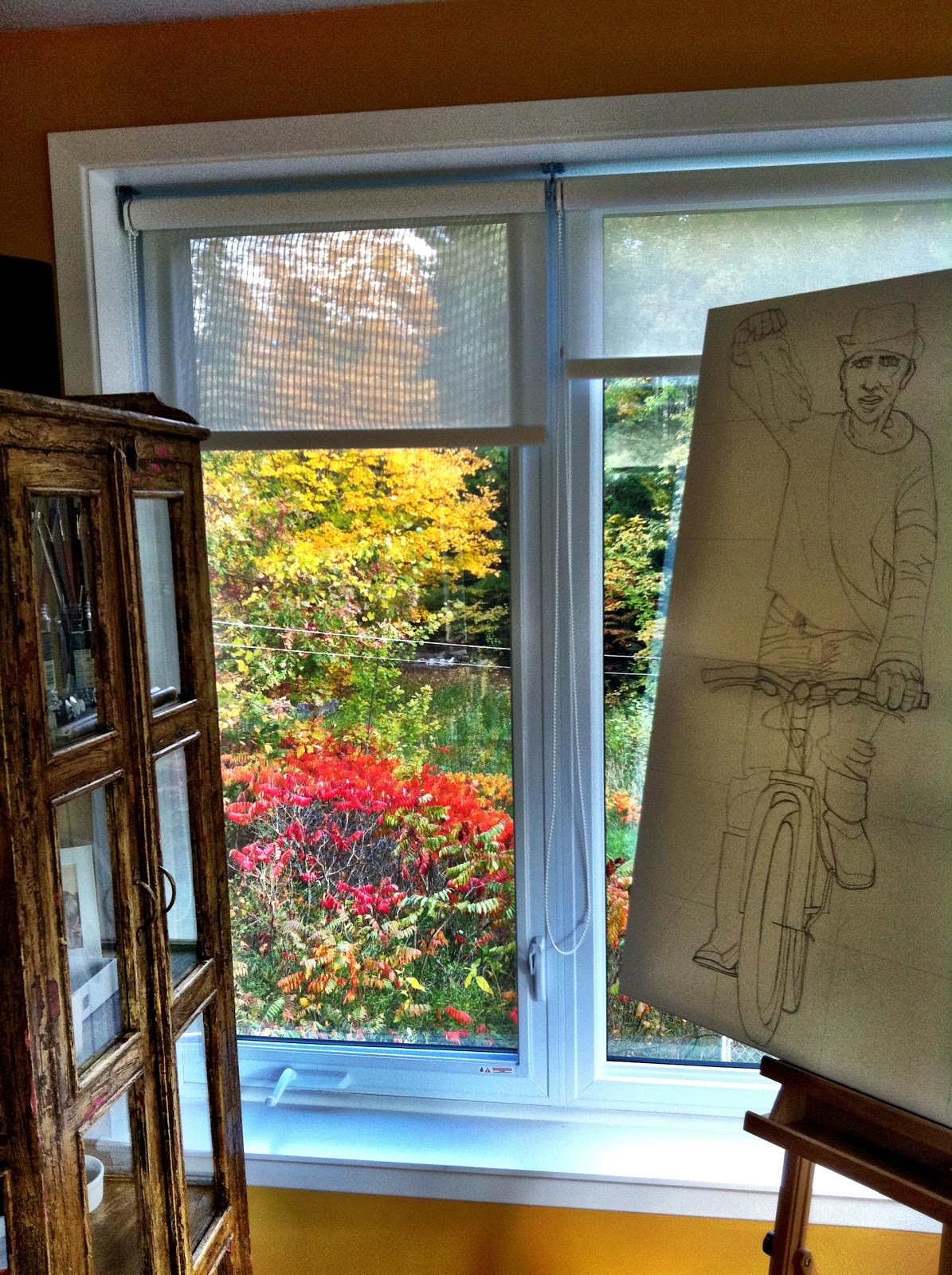
Angela paints.  She is working on her largest canvass to date.  Along the very bottom she has painted a few boats tied to a pier.  Originally two of the boats were named “RESCUE,” and above them was a blue sky. 

Enraged, we looked at this image stupidly. 

“I do not need to be rescued,” our bear finally said. 

Now the sky is emblazoned, painted and repainted with variations of red, yellow, green, grey, blue.  The boats too are bolder.  Once named “rescue,” they are now called “COURAGE.”  

When I am not at work I have taken on dumb tasks.  We lost our internet connection recently so I have spent evenings booting and rebooting the modem.  I have jumped through hoops for technicians in India and New Brunswick who take me through various sequences of plugging in and out the modem, router, computer and so on.  The satellite people tell me it’s the router, the router people tell me it’s the modem.  They cannot know what anger I am displacing onto this.  Foolishly, while Angela slept the other day, I drove to Belleville to buy a new router knowing it wouldn’t work.  Finally, I am promised a visit by a technician.  Finally, like Angela, I am also finding courage.

We do not want to jump to conclusions.  We talk casually in the mornings about where we might go for Christmas.  We contemplate the potential for scar tissue and tell ourselves that these lesions may not be what they appear.   Angela reassures us that she feels strong.  Against the CT and x-ray images we have her blazing sky.

I blame the timing of this, in part, on Angela’s lifelong submission to the academic calendar.  We hoped to avoid a return to work this September, but in this, my friends, we know that we are not alone.  We are grateful for the continued words of encouragement that we still receive.  Let us not waste our time on dumb tasks.  Let us not paint things only as they appear.  Let us all return to work however we must, and let us all…be in touch.

Monday, 6 August 2012

August 6, Patio

Saint George and the dragon still clash above our fireplace.  Even in battle the knight's face, and the postures of both combatants, are prayerful and calm.  Like Rocky, though, Angela and I are now spending much less time at the hearth, and more time in the sun.

We visited the radiation oncologist last week.  He tells us that there has been no change on the most recent MRI compared to the last.  This, of course, is very good.  He has ordered a repeat skeletal survey, xrays of the rest of her bones, to be sure the cancer has not taken up elsewhere.  Angela, smiling, tells him not to worry.  She says, for the moment at least, she is feeling better.

It is hard to know if our bear's symptoms have improved.  Her determination, though, has continued.  Still she is up repeatedly in the night to "reposition."  When she is lying down, unless her arms are stretched out straight, they quickly grow numb.  When she drives to town she is sure to nap beforehand lest she fall asleep at the wheel.  There is, still, so much care required for simple tasks.  Irrespective of her persistent symptoms, though, our bear, clearly, is getting stronger.  She is driving herself to town now a few times per week.  She is walking Rocky down the highway a little further each day.  Wherever she goes, however far, she seems now to come back with photos.  She takes her iphone everywhere and pays close attention to everything.  She has captured some remarkable cloud formations, and at least one oddly beautiful insect.

For Angela's birthday yesterday we made a trip to Ottawa to visit the Van Gogh exhibition.  He too was crazy about tree trunks, insects, and clouds.

charity and good homes for old books
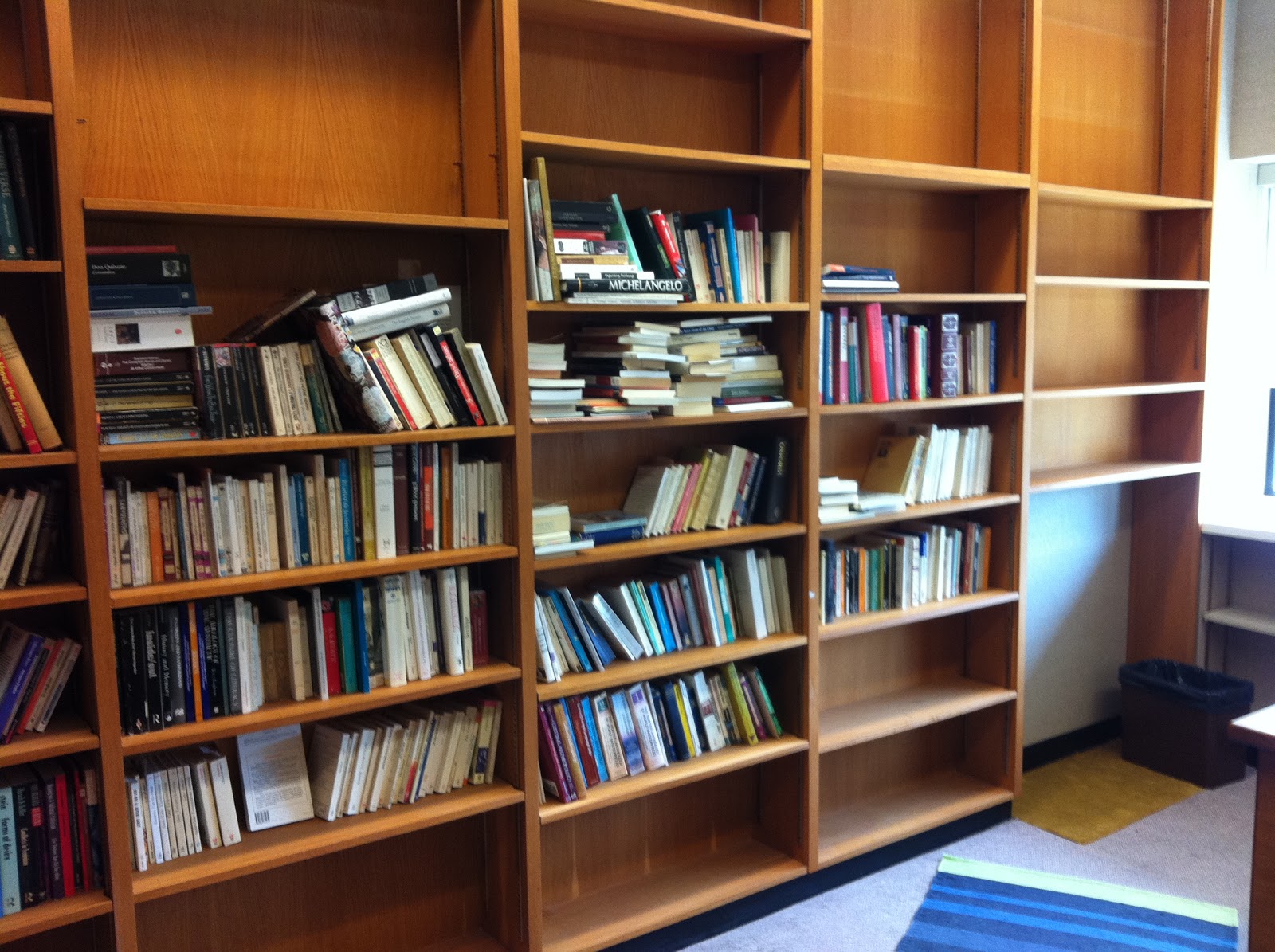
We boxed up most of Angela's library recently.  Still she cannot write without tingling and numbness.  She cannot read without sedation.  She cannot do either without a certain amount of grief.  For the moment, at least, we need some space on our shelves.  Today, we are rearranging our furniture.  We have the happy feeling that there remains plenty of space for new things.

We have started, it seems, with canvases. Angela continues to paint.  After some self portraits she has painted a couple of me.  Somehow in the paintings I am restful and calm.  In one I am asleep.  A pillow is under my head.  My eyes are shut.  In another I am slouched in a chair.  Angela, with her painting, is wishing me restful dreams.  It is true that the dragon had tired me out.  In recent months, though, as if to restrict my life as much as Angela's, I have been taking on many more responsibilities in my work.  My workdays are long.  In this way Angela and I retain the same pace.  I am grateful when I am away for the photos she texts to me of the clouds, and of Rocky's shadow on the grass.

We celebrated Angela's birthday last night with some wine.  Happily a glass of wine has become palatable again.  The sun has been beating down heavily on everything this summer.  Happily it seems to have slowed everything down.  We moved from the fireplace to the deck.  Forgetting the dragon for the moment we are toasting Angela's health.  Remembering Saint George we are staying prayerful and calm.

We know it has been a long time since I have written on this blog.  I do not have the strength of Van Gogh, whose paintings I now love, nor of a polar bear, or of Saint George, but I am grateful for our friends, and, ultimately, I will try...to keep you posted.