Sunday, 2 June 2013

June 1, what feels good


A day I awaited with so much anticipation and yet a day which did not start well. By 6 in the morning, Ben was barking his 'I am bored' bark. 'I want you to come down' bark. 'I have something to show you.' 'I have done something I am not sure about.' 'On the one paw I might have done something wrong, on the other, I am super excited  because what I have done will certainly elicit a rise of you guys.'
 

I came wobbling down the stairs and took a comprehensive look at the lower ground. This one was about shoes. Or rather, slippers. The last ones Ben has halved were John's, Colin's father. We offered temporary replacement. John was a good sport about it. Right now the situation a bit icy. Colin loves his clogs. They're one item he cares about and should put away at night before going to bed, given past experiences with objects of all kinds: feather pillows (3), blankets (2), oranges, bread, just finished and ready to eat salads, pens, pins, screws, cushion buttons, rugs, pet brushes, plastic bags, plastic containers, pretty much anything that happens to be near his nose while he's waiting for us to appear from the upper floors where we please to hide at night, behind the dog metal gate which, of course, has been chewed on too.

Colin was not too upset. On the bright side it was maybe time for a new pair of such comfortable, foot imprint-on-the-insole kind of clogs. While making the second round of lattes, I realized that Ben's bark had awakened me from a dream where I was trying on a couple of exquisite summer, walk-on-the-water sandals, from the store a friend had just opened, or, rather, was trying to open soon.

By the time we got to the yoga factory the day had declared itself, soft and humid. In the driveway three poppies in full bloom said a cheerful hello, while the lilacs, already loosing the grapes of their youth, were sleeping in.

We carried our respective mats, a bit thicker and softer than yoga asceticism would require. Mine having been laid a few more times than Colin's, which is brand new. We have bought his in Montreal, a few months ago, when, after visiting with friends, we happened to stop by the Forum, on our way out of the city. Looking for pastries, as I usually am when we leave any city at all. We had decided to do yoga together at home. And what a good omen, that that yoga mat should come from a place Colin worshipped as a child. Since not much is left of that universe, but a bronze statue in the midst of what looks like a void waiting to be filled, derelict and sad.


The session, two hours long; the asanas responded to my description of Colin's more present and pressing aura of need: he is the one who carries three men on his shoulders, three male colleagues, who, irrespective of their material weight, may at times weigh quite heavy on his sleepless nights.


In spite of that, it was the figure of the child which played in my mind during our practice together. Within that space, I am usually in the presence of women. And since I do not know them, I try to be discreet and look in their direction as little as possible. It is a kind of privacy I appreciate in this group practice. With Colin though, of course, it felt very different. It is exhilarating to be doing something we had never done together before. Couples who have lived together for a long time know what I am speaking of. It is one of the secrets of a lasting couple, to invent new things to do, and, of course, new things to talk about. Not always easy. And I am not speaking of high degrees of danger, exoticism or eccentricity either. I know of women who would love to have their partners partake in their yoga practice. For the men, it is close to impossible to accede to this simple yet so meaningful demand. I do not pretend to know what makes it difficult for them. But I will admit it was with an extreme and grateful surprise that I heard Colin say yes. 'Do you accede to your spouse's demand, that you shall go with her once a week,  to practice yoga, in illness and in health? Yes, I do.' That's pretty much how it felt.

Of course I realized quite early that I would not be able to direct him in his practice at home, let alone both of us. Those are skills I would have yet to acquire.

Going back to the figure which playfully occupied me during this first session, the figure of the child. It appeared to me that this practice, at least in its beginning stages, has a lot to do with how children employ their bodies, manner which they are forced to renounce as they
become adults. And I doubt it is only a question of easy transposition. Making the names of the asanas accessible in English, as they say. The fact is, in yoga, one is brought to recall many of the positions one practiced naturally as a child. As Karen, our instructor, puts it so well, and often: whatever feels good, whatever feels right. It feels good to lay on your back and take hold of your feet, or toes, while bringing your knees close to your chest. It is rightfully called 'happy child', even if in translation or transposition only. It feels good to lay on your knees, face down, cheek on the mat, arms by the sides of your head, bum up. This bum up, face down, which we so rarely do just for fun, when not searching for an earring lost under the bed, where do you go to practice as a way of freeing yourself of whatever you carry on your shoulders? Where do you dare thread one arm under the other, while laying on your face and knees, bum up? Both our dogs, on the other paw, know all about it.

Children, dogs, cats, warriors, trees, bows and arrows, bridges, and yes, the corpse, all come to brighten your day. And there, in the aptly called yoga factory, you are allowed to make of the bum up, head down, arms hanging loose whichever way feels good, a purpose in itself. It was, of course, a special delight to have Colin there with me. His wide hockey player shoulders turning, slowly, to the left and then to the right, long, straight arms perfectly parallel to the ceiling, or to the sky, torso gracefully sustaining a lighter head, for once only attentive to the unhurried rhythm of his breath. Spine long, eyes gazing softly, stealing a glance in my direction now and then, like school children amused by their secret plan to shyly behave. 


And then we laid down for the last asana, that of the Shava. While Karen's voice was reciting all the places, along the body, which our breath should visit, embrace and release, a bird, maybe a robin, was chanting her own privilege outside. Clear and distinct bird calls addressed to the fortunate day. We answered Namaste in return. Somehow, it felt utterly right to do yoga in the country: barefooted, and attentive to our dog's early example of doing what feels good. Oh! that trustworthy destroyer of all those worldly, comfortable, material things!




Monday, 20 May 2013

May 20, mellow yellow

they call me mellow yellow


The other day, just before finishing this painting, I showed it to my cousin Stela who replied, nostalgically: "I wish we were having coffee together right now."

This still life is therefore about the pleasures of conversation while drinking coffee together. We bought two of these cups in 2003 on the Danforth. That Provence store has closed many years ago, yet the precious cups served faithfully and still accompany us in our most cherished morning ritual.


Friday, 17 May 2013

May 17, the invisible woman


A frequent and justified complaint of "women of a certain age" is the fact that, at some point in the maturing process, they become invisible. It is particularly the regret of those for whom looking good, being admired and courted, however innocently, was a customary experience of youth. Those who used, upon entering the proverbial room, to be taken note of and hopefully spoken to. In other words, those who neither enjoyed nor preferred the anonymity of being one of the crowd.

The day comes, for most of us, when entering a room, from the restaurant, to the Future Shop, to the garage, ceases to be a comfortable activity. Catching the eye of the waiter, of the sales person, of the mechanic, be they man or woman, becomes a challenge. After a few such trials, the woman undergoing them finally, painfully realizes she has entered the ranks of the invisible. It takes another few years to actually get used to this condition and thoroughly forget how things used to be. Fortunately this act of forgetting is quite thorough, a process of amnesia smoothing over the pleasures one secretly harbored when one was taken note of.

There is one parallel experience to that of having a remarkable or remarked exterior appearance. It is that of speaking with an accent. That is, speaking with some approximation the language of the land, and particularly of that land immigrants have somehow chosen to avoid. That is true especially if one is not a visible minority. For her the surprise of the addressee shows its full weight. Yet the comparison between striking appearance and accented speech stops here. For nothing pleasant can emanate from people who seem to suffer physically when exposed to words pronounced in a different manner than the one they are used to.

One of my aunts, whose 92 birthday is tomorrow, warned my father early. I was probably not yet 14 when she told my father his daughter liked to be looked at. Not that he needed warning. Curiously enough though, my father, the very soul of  Balkan paternal rigor, was not exactly displeased with this form of theatricality. While his right of veto was brought to bear upon most, if not all things a 14 year old girl would like to do, he was not against miniskirts, high platform shoes, light blue sunglasses which he himself procured for me on the black market. He took some pride in those jealous gazes coming in my direction from one and all. And since he allowed for so few liberties, I grabbed this one with both hands and run with it.

During my now customary visits to Toronto, I like to take the subway and people watch. The other day a woman let me know she liked my gloves. She then looked me over and said my glasses were to her liking also, as well as my skirt. Finally, the whole outfit agreed with her esthetic judgement. Had I done that on purpose? Yes, I said, although caught by surprise by a question which normally would have me burst out laughing. Of course I had done it on purpose. All right, she retorted, it was all right to do such things. Her meaning, I suppose, that it was all right to spend one's time thinking about matters of little import like these.

From the corner of my eye I appraised her after, trying to figure her out too. About my age, maybe a bit older, carefully but conservatively dressed. It is almost a rule, that I get compliments from conservatively attired women, those who let me know, one way or another, that they would like to take such liberties as I do with their outward appearance, but of course cannot. For serious people with problems on their mind, it is out of question.

A few minutes later, still intrigued, she came back asking where I had bought those gloves I was wearing. Brown with white polka dots, driving gloves. Was I using them for driving? Yes. They come from Boston. And the skirt? It is German. The glasses? They're French, but I bought them right here in Toronto. All these items come from somewhere, of course, it used to be a habit of mine, in the days when I was traveling, to buy certain things which would remind me of the pleasure of that particular voyage. (I will not say that particular conference, although that may be true too.) Right, she finished, while stepping out the door of the train, but Boston, which she had visited a long time ago, was a city she did not like. People there were not friendly, maybe because of ethnic rifts.

I refrained from analyzing this last remark and in the evening, looking at the events of the day, I texted Colin and asked why it was that women only declared their liking for my outward appearance and not men? Colin's answer: men were afraid such a gesture would be taken for an uncalled for advance.

The next day I took the train in the opposite direction. I was carrying some bags and when a seat presented itself I took it quickly. As soon as I sat down the man to my right looked me straight in the eye, smiled and said something, at the same time as I smiled back and excused myself, calling the bag I was carrying by its name: Leonidas chocolates. Because he was rather heavy set, I had automatically taken for granted that he, of the kind smile, would like chocolates.
Very soon though I realized his comment had to do with my glasses. I thanked him and he pursued: one has to acknowledge every day what one admires. In a beautiful turn of phrase I unfortunately cannot quite reproduce. I felt fortunate to be his object of admiration on this day and sat quiet and slightly mesmerized. He was reading a book on loan from the library. Was casually dressed and  did not have, as I said already, the body of an ambitious young man, but rather, of a middle aged who spends many hours either at a desk, or reading.

I could not not expose to him, in a few words, the other day's conundrum. That, insofar as chance encounters are concerned, for a long time now, and until I met him, it had been women only who had given me the gift of a compliment. He answered right away, as if prepared, and, with the same gentle yet quite more animated expression, said simply that men were cowards. And added that my smile was even more lovely than my glasses. After which his station came up, and we said good bye.

Yet, what felt particularly good in these ephemeral encounters was the fact that neither of these two strangers was surprised or befuddled to hear me speak as I do. They did not retreat in shock upon hearing my speech, as if too close to the mouth of a fire blower, reaction I have become accustomed to provoke here in the Hastings county. Neither were they confused by the riddle of my words. They understood what I said and were at ease with continuing the conversation, I dare say even regretful to abandon it, without asking those questions which people who do not befriend the immigrant species feel compelled to ask. Like for instance: how come, that after more than thirty years in Canada, you still have such a thick accent?

Let us say that the thick accent, and the unusual combination of disparate articles of clothing, belong together. It has been somewhat of an awakening, to meet these people who, in different ways, exercised their duty, compulsively or self-imposed, to express admiration when an object engaged them. I have wondered whether I myself could not follow the lesson of my unknown bookish friend, and try to do the same as consistently as my courage will allow me.


Monday, 6 May 2013

May 3, Open doors


Summer is here, and as often in the past, there was little transition between winter, and these hot days. The orchestra of critters of all sorts, birds during the day, toads at night, keeps us awake and mesmerised. The wind can now play with laundry hanging outside.


I am becoming organized again. Something to do with the train. Every second Monday I take the 8:17 to Toronto. There, I spend a couple of days in order to pursue my new treatment: enjoy the benefits of friendship, psycho- and naturotherapy and people watching. I use the expression in the sense of “bird watching”, since it is my unexpected, present position, to spend my days in the midst of birds and only rarely of people. When this Via adventure first started I did not think I'd be able to withstand two entire days out and away. I did not think I'd be able to stand or sit for so many hours, considering that the reason I sought therapy in the first place was extreme fatigue. Yet here I am, two months later, able to keep this commitment from one excursion to the next.

The city of Toronto is so much friendlier when one is a visitor, the transient beneficiary of its riches, rather than its permanent resident. Besides my renewed practice of mostly traditional psychoanalysis, to which I remain attached just as I do to Greek Orthodoxy, the yoga exercise has opened the way to the office of a naturopath.  Incidentally, that is thanks to the mediation of the generous friend who allows me to nest in her house. It has been a soothing discovery, this submission to hands that know and can help the workings of your body, inside and out. It is not easy to understand how such subtle, non intrusive intervention can have the powerful effect it has. Only seldom are we allowed to entrust our body to a person who takes control, in order to alleviate our pain. The feeling of gratitude which comes to the surface as the hour progresses keeps in check those wondering thoughts which so often command that we stay vigilant.

My yoga instructor’s French is excellent, while the osteopath is a Maghrébine. The piano lessons we conduct in French, and it was my wise piano teacher who noticed this tendency I have to find, without looking, people who have some attachment to that language. It might be equal parts of a lifelong therapeutic quest and its traumatic counterpart, I suppose.

It remains that, with the coming of spring, if not already summer, the isolation this long winter past has imposed on me, the difficulty I had to get out of the house, has been replaced by truly new forms of activity, and new friendships. In winter, the one person I met regularly, in the pursuit of a form of healing to which I owe much already, was Heidi. Next to her, and those long distance piano lessons, there are now quite a few other women waiting for me behind their open doors. Miraculously, at the same time, we found a young girl, strong and kind enough to want to take care of Ben, Rocky and Alice while I'm away.

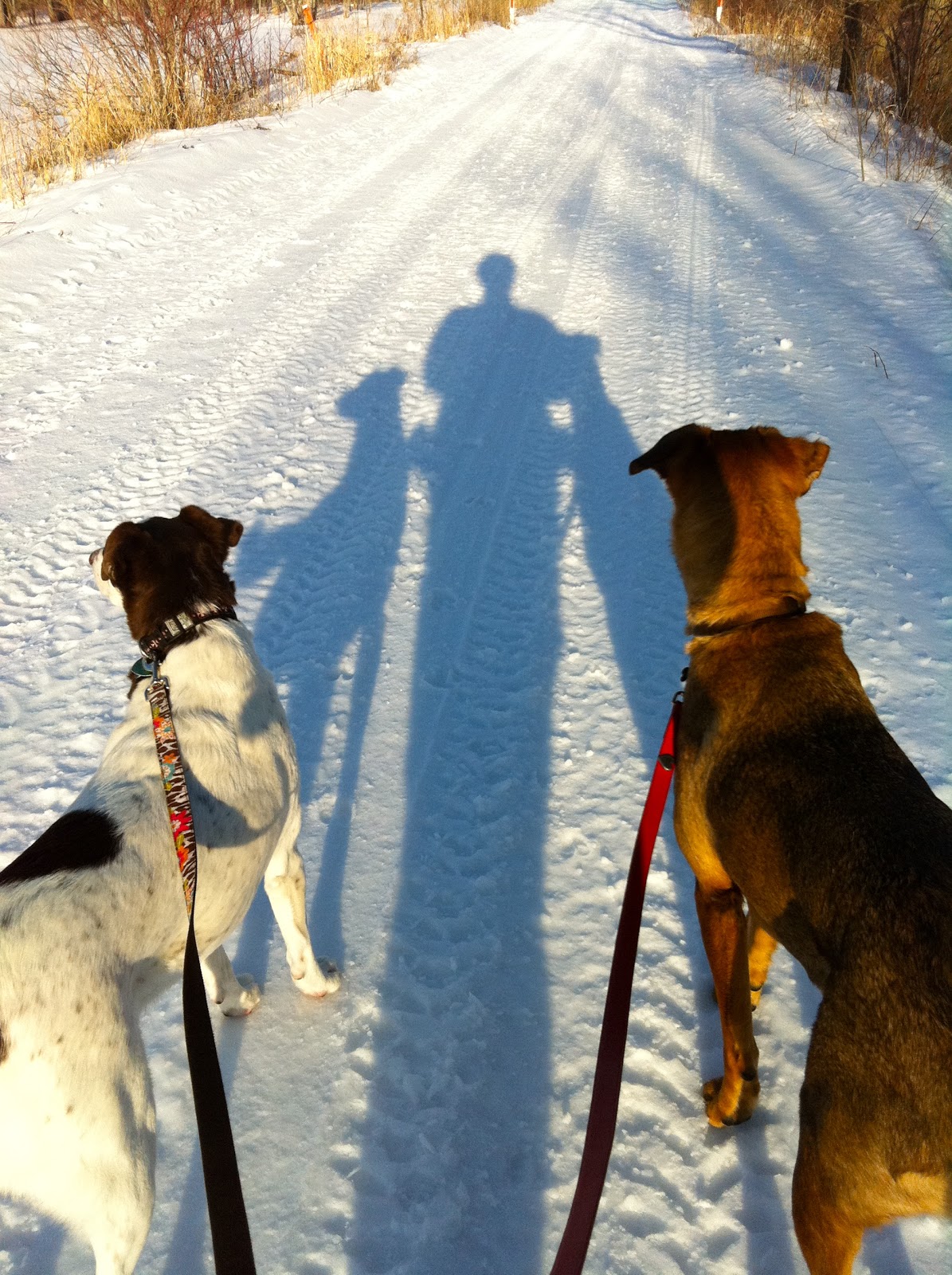
rocky and ben, otherwise known as spooky and spook


I suppose this entry is about new friendships, new acquaintances, a new manner of being, and the endurance of some of the old, under new forms. Given the feelings which animate me at the moment, and in the name of all of us, who, by the meadow, cannot but enjoy the stillness contained in every sunny day, I wish you a wonderful summer.  May many a critter symphony accompany your starry nights. 


Wednesday, 10 April 2013

April 10, Yoga


I had left early because I did not know how long it would take me to get there. Turned out, the extinct cheese factory is a mere ten minutes away from our home. The yoga instructor had told me to come early so I'd have time to fill the health form.

She is petite, slim but very muscular, very well formed, as if the delicate miniature of a perfectly life sized person. Young but bearing the trace of something more powerful than herself - maybe some past sadness? maybe more simply the work at the farm, where all kinds of animals, among them goats, give birth at this time of the year ? maybe the cold and damp winter just behind us. She looks at me with a direct, frank gaze, yet cautiously, not sure what to make of such a client. 

The "cheese factory" is a large room with a few windows looking out upon the bushy landscape. The day sunny but crispier than one would have liked, with a nasty cold wind blowing through closed doors and windows. The two electric heaters have a hard time doing their job. I keep my socks. People of the north have a different threshold. I am spoiled by the ever-burning logs in the fireplace and have no tolerance for winter and cold any longer. Sit down on the chair waiting for me, fill the form, checking most that is wrong with me at the moment, but not all.

Karen comes back and we chat a bit. It does not take long before we switch to French. A master's degree in French translation, of no much use right now, but which explains her language: careful, cultured, faultless.

Besides myself and two elderly ladies on whom I count to keep things flowing nice and slow, a handsome tall woman came in, a caryatid carrying an authentic if casual aura about her. Turned out, she was the instructor's instructor, and did things better than right. I wished I had put myself in a position wherefrom to observe her without turning my head or peek from the corner of my eye in astonishment, impolite. I had to content myself with feeling her presence encompass the large, now resonant room, where Karen's words float soothingly and firm.

A week went by and today I was impatient to get back to the cheese factory/yoga studio. Kept looking at my calendar and counting the days. The day after the first class, I realized I had run into a very capable instructor. That next day, I woke up feeling the workings of my body in a way I had not in a very long time. I would maybe have to think back to when, as a child, I spent hours playing or swimming in the generously salty Black Sea, which offered the body and mind the freedom to float as they pleased. As if every part of the penitent incarnation that I have become had regained some right to say "I'm here and aware of what I'm here to do". Some parts only minimally, maybe, but working.

The first class, in the presence of the caryatid, had been dedicated to the theme of the tree. Which I, for sure, would have greatly appreciated a few years ago, when I kept complaining about the cement bareness, about the scarcity of vegetation in the big city, and that, in spite of Toronto's fare share of beautiful, strong trees. But since we live in the country, the tree is at the center of our life, the house built in the midst of oak trees who now grow in a circle around and hold it steady. So, when Karen suggested that we imagine a tree, I had some difficulty choosing which one of those.

Then she wanted us to imagine the place where we are at peace with ourselves and the world. I paraphrase, but I'm sure you know what I mean. The place one can call one's inner refuge. Like in the case of the tree, I found that difficult to do, since this place where we now live is supposed to be our refuge, the place where we, or at least I, have retired, willingly or not, from the world. Yet that place of peace cannot be attained, or I do not think it can, since one cannot live in that utopic place day after day. And since we are tempted to think of it as a place in nature, rather than in the city, I had to go to my next best place, which is a beach in Cape Breton. And maybe not so much to the beach, as to the ocean, that marvelous day when we went swimming, a few years ago, and everything, the water, the sun, the wind, the sand, was perfect.

Except, this beach went hardly along with the theme of the tree and rootedness, which I had, in my imaginings, replaced with floating and letting the waves take you wherever they would, body turned in the direction of the sun, eyes closed, volition renounced.
Instead of rootedness, there was the drifting with the current, instead of the meadow, on which we set eyes every morning, as we wake up, there was the beach and the warmth of the sand.

I knew I was not following as I should have, but the theme of the tree, related as it is to the vertebral column, marks that moment when my imagination wants to take a pause. In the hope that the upright, firm, well centered posture may be helped, if not replaced, by other forces, which may flow haphazardly. Yet kind and smooth enough to maintain, to lull the body back into some sort of joyful suspension.

Tuesday, 19 March 2013

March 18, Pioneer


Here is the questionnaire you have to answer before you visit with your doctor: on a scale from 0 to 10, let us know about your pain, appetite, sleep, mood, drowsiness, fatigue, nausea, etc. It used to be a photocopied form we filled casually with a blunt pencil. The nurse would take it just as casually and put it in your chart. Then she would ask her questions again, and take some quick notes.

I who, in spite of the evidence, thought never to have come close yet to this pain of 10, "worst possible that you can imagine", settled often for a 5 or a 6 in the early days, and now will pick a 3. On the other hand, where mood is concerned, and satisfaction with life in general - or what is called in the medical jargon "quality of life" -, I would give myself a 2 in what I call the early days. 2 out of modesty, since, happy to be alive, I would have put down a perfect 0, were it not for my internal censorship.

Yesterday we arrived at the cancer centre in Kingston and had to wait in the loveliest waiting room of the new building, which feels more like a theatre hall than a hospital, and looks out on the lake. We had to fill the same form, this time directly on the computer. Obtained the printout and, to our surprise, found out that the data, for the last 4 visits, had been compiled on this one sheet. Therefore, you could tell, by the numbers, how I "progressed" within the year that passed, and from visit to visit, 4 in all. While most rubrics looked unremarkable - the pain somewhat the same, just marginally better, which is the case, same with sleep and appetite -, under the rubric of mood the difference was striking. Colin made the first comment since of course he knew what that was going to let loose. I protested and brought to bear my best philosophical argumentation. Of course a year ago I was happy to have prevailed over the tumor with radiation only, happy to be able to come home, happy to take up life again, even if in a new form. One year later, though, the isolation which so much contributed to my recovery has become difficult to bear, and the fatigue, which, in the beginning, was the promise that, through sleep, I was going to heal, now is the most difficult part of my convalescence. Now, that I am able to read at all, I protest not to be able to do that for more than half an hour without having to sleep immediately after. The same is true for writing. Or for any other activity that I may undertake. Those conditions of slowness, which I so welcomed fifteen months ago, have come to put my patience to a real test.

That this may make sense for Colin is one thing. But then, here comes the nurse, she who remembers what I was and looked like then. That end of november feels, for her, like three, rather than two years ago. She goes straight to the mood rubric which was, I confess, impossible to miss. These values are expressed in columns and this particular column, unlike others, went from barely a line to quite a square.

She took another look at me and wondered, for a moment it seemed like I had a stiff neck. Colin reassured her, that was not the case, but rather, our lovely new dog Bentley who is young, strong and playful, and not used to the leash. Which makes walks real tugs of war. The iPhone came out with the proof. Earlier, at the pain clinic, during our morning appointment, we had had to answer the question whether, since our last visit, there had been some, little or no improvement, with some, little or no thing to show for it. Even if initially we thought, "no improvement with nothing to show", I reconsidered and advocated for "some improvement with something to show", since, had there been no improvement, there would be no Bentley. Of course, these questionnaires do not have Bentley rubrics, only numbers.

When my favorite doctor - we share a similar temperament - came in, I tried to remind him that these are just numbers. That I had been a working woman all my life and that ceasing to be that kind of  person could not come easy. That I would have preferred never to have had to work, but since that had not been the case, I found myself now forced to mourn the loss of something I always wanted to loose.

Because, indeed, I always wandered, what would it feel like, to be an artist who did not have to work for a living? I may be, right now, quite close to this position, except for the pioneer quality of my present circumstances, which I did not expect to go together with the other. A convalescent pioneer who tries to do some writing and painting, and even a bit of music, and has to, once in a while, rate on a scale from 0 to 10 the quality of her pioneering experience.

As you may know, I have been a pioneer before, and so very proud of it too. But that is another long story. Nonetheless, I remember looking aghast at some of my schoolmates who, on the special days - like the first of May - when we were supposed to wear our red triangular scarfs, white shirts and black pleated skirts, came to school with a crumpled tie, stained and torn at the corners, hanging whichever way around their sorry thin necks. How did they not wake up early in the morning and iron that tie, that shirt, carefully washed, by necessity by hand, the night before? By their mother of course, or grandmother, whom they would have pestered at length, insisting on the importance of looking good in this outfit? Dirty tie had nothing to do with poverty, for sure, and I did not really have the concept in those days, not only because we were all poor, but because my own grandmother made her living out of laundering other poor people's belongings.

Well, you will say, what does that kind of pioneering have to do with the pioneer you are now, opening every day, through the snow in winter, through the clouds of mosquitoes and deer flies in summer, your trail, to the back of a property the Canadian government did not give you for free to clear and cultivate? Opening which does not even presuppose that you wear a red tie, although tying something around your neck to protect it is always a good idea?

Somehow, upon first laying eyes on those questionnaires, at the doctor's, the thing that came to mind were the students' evaluations, the bane of each and all teachers, except for those precious few, who are always superbly admired by their students. Not having been among them, I can reckon that one of the freedoms I have acquired, in my life as a convalescent, is that of not having to be given a mark for my work performance. But wait! I still have to, I have in fact to give myself a mark, for how I do, in comparison to how I did. And when it comes to mood, or the well being of the spirit, if we should use such an obsolete term, it appears that the task is all mine. What seemed a 0 is now an 8 where 0 stands for perfection. We rely here on a system which definitely believes in progress. And I am afraid, if 0 came at a time when things were pretty bad from a medical point of view, what chance does one have, to improve on that? If being a pioneer was such a delight under the communist regime, how am I going to compare the pioneering I am practicing now, and expect it to win?

Am I trying to tell you that there is no improving upon the original experience, no matter how difficult the conditions might appear to have been then, to the objective eye? Possibly.

Wednesday, 6 March 2013

March 8, Women's Day


I had forgotten all about it. By 1996, more than 16 years after I had left my country, this kind of holiday had been replaced by others, meaningful in a very different way.


The approaching publication of my first book was an event of extraordinary proportions for the one who had been working on this, originally doctoral thesis, since 1984. I know it sounds unbearable and it is.

People outside the university often think that university jobs are easy. They count the number of hours one is expected to teach every week, they look at summers which appear to be work free, and wonder how such jobs are still possible nowadays, when business people work so hard, with so little security, etc. In fact, the reason I do not like to remember very often how I got that first position is precisely because, when I count the years it took, to put together a curriculum vitae likely be taken into consideration, I shiver. Of course, when one is young, life seems never-ending. It helped, that I liked to read and write. But spend twelve years on a book that nobody, including myself, remembers any longer? A book whose main virtue proved to be, to put me in a position wherefrom I could do the same a second time?

Of course not everybody takes this long. There are, fortunately, people who think fast, write fast, and get things through with ease and successfully. Of course.

That 8 March 1996 was the last of many days I had spent on the phone with the man who was doing the editing of my book. (We did not have email in those days.) This book had been read and proofread many times before, but he did not quite trust those. He was a better editor anyhow.  I too must have sounded somewhat untrustworthy. He had never seen me, I was neither in Montreal, nor from Montreal. He kept sending me back to my text, kept saying, as others were to do after him, that this is not "how you say it in French". The book contained an awful lot of quotations, that is, translations from German, from Spanish, God knows where else, and it certainly sounded very little French-like. It could not have. At some point, the editor himself, embarrassed by his lack of patience with a job he was paid to do, but of which he thought little, excused himself by saying that he regretted to have to do this to me on women's day. Obviously, being a québécois, he had a political conscience. That did not stop him from being rough with my work, with my general contention that I had written something worth publishing, but well, since I had been awarded the necessary grant, he had to do his job. It did not mean that he would do it nicely, of course not. Do it, and in the process spook me away from coming back another time.

From the depths of my embarrassment, I remembered those 8th of March days. I remembered the endless hours children spent making gifts for teachers and mothers. The festive, perfumed feel of it all, the fact that back home, March meant the arrival of spring already, with small delicious bouquets of snowdrops and violets to prove it.
Meanwhile here, when I had reason to rejoice in my accomplishment, it somehow felt riddled with difficulty and closer to rejection than joy.

A few weeks later I drove to Montreal from London, where I lived, to pick up the copies of the book to which I was entitled. I found my editor at the publishing house, in the midst of boxes piled up to the ceiling. All those books now published, which were probably never going to be bought, in spite of having been so thoroughly edited and proofread. I got my box from this very polite man, who in my presence had become almost pleasant. Nothing in him betrayed the grumpy phone demeanour. He had the appearance of the 70s intellectual, long if thinning unkempt hair, complexion fatigued by one too many nights spent drinking and maybe writing. Nothing so boring and thesis-infused like what I had produced. A master of his native tongue, without a doubt.

We had an uneasy lunch in an empty bar and I took off in a rush, impatient to take a closer look at my precious book, which I could not have done in his presence. Stopped on the side of the road, took one of them out, it smelled so good, so fresh, so perfect. I looked at the back cover, the one known to matter to the first time author, the only place where any mention of who she is may be made, if at all. Maybe there was also a small picture of me? I do not remember. But I don't think so. This was a serious, academic press, where they do not indulge in portrait narcissism. My attention on the spot arrested by the typo I could not not notice even before reading. Not a big deal at all, simply a word repeated twice, nothing horrible. The small preposition de. Yet to me, at that time, this was a disaster. After weeks of having had to listen to how poor my written language was, that typo, left to fester in such a noticeable place, loudly spoke about how this chap had not done his job properly. He was very good at telling one what they had done wrong, but not so good at doing things right himself.

As you can see, many years have gone by, yet I still cannot forget that de. It took the shine off the publication of my first book. It should not have done so. In time I learned to rationally submit to the difference between what is important and what is not, and a typo certainly is not. It remains a fact that for years after, that typo came back. Every time I had to subject myself to comments concerning my writing, coming from people who invariably thought they could do better than I did. In a way, that typo on the back cover bio, brought a certain perspective to the act of writing and publishing. Writing was a form of giving, followed by a silence. That silence is sometimes marked by a typo, let us call it an X, the acte manqué by which my poor editor had manifested his disapproval and revolt.

I am tempted to say, let us imagine, on this Women's Day, that the best way to fill that silence would be, instead of the X, the wordless fragrance of a small bouquet of snowdrops, for the dark-haired, of violets, for the blond, and the grey. Let us all go back to our cheerful, communist spring.