Saturday, 19 January 2013

January 19, Decisions


For Oana

Decisions (1): What kind of work and why

The year was 1981 and I had lived in Canada for about eighteen months. Lucky to find a job a week after I arrived in the country. Calgary was a boom town living up to its name. I had been hired as a drafting apprentice in a geophysical consulting company where, for $500 a month, I was taught the rudiments of the trade.

Two seasons later, Mobil Oil hired me for $1200. The working conditions were not as tolerant in the face of daily error, but the money was much better. I came close to consider myself well off. On which comforting thought my most pressing fear, that of being uncovered as a fraud, was throwing its long shadow. My basic skills were limited and my work, so slow as to hardly justify, in my own estimation, the wages I  brought home. I tried to take courses in geophysics, improve, get on on the company ladder, since opportunity was knocking at every door. At the Southern Alberta Institute for Technology, they were churning technologists off the conveyer belt, the land was swelling with capped wells, the company happy to pay for training. But the number of indistinguishable rock samples was so daunting, I had to admit neither geophysics, nor its more artistic counterpart, geology, were my calling.

The afternoons at the office gradually more difficult to get through. After lunch, and everybody ate hefty in those days, I could hardly keep my eyes open. Not unlike how I feel today, as a result of sharply different reasons. I would gladly have put my head on the drawing board and fall asleep, were it not that my desk was in the middle of a large room I shared with fifteen people.

The only way in which one could chase sleep was to chat with one's colleagues. I had a few who were glad to see me come visit under the pretext of looking for advice on my mapping. Gaby, my Hungarian friend, was close to retirement, and neither sleepy nor troubled by anxiety concerning his duties. My other conversation partner was my boss, Laszlo, another Hungarian. These men, who had come to Canada with the 1956 revolution, did not know much about communism, but a lot about what to do to avoid it.

As with all immigrants at the beginning of what is called their new life, I had already incurred some debt and begun to experience the impossibility to bringing a credit card balance to 0. My parents made quite a bit less money than I, so I helped. Gaby kept talking about university. He had a very smart approach, which consisted mainly of praising my intellectual talents. I had left Romania in the midst of my third year university studies and never thought I would go back. All advice from that corner insisted that I renounce any ambition of intellectual pursuit. The West was all about making money and such endeavors as the intellectual ones were not rewarded. Which proved quickly not to be false. I also had this misconception, many people of my whereabouts entertained, that, at 25, I was already too old for school. How was I going to pay for my studies, my livelihood? The best advice Gaby gave me came in the form of a simple calculation. He said, yes, you are 25 now, in four years you will be 29. The time would have passed anyway, and you will ask yourself, how did I spend it? You can stay here, or, you can go look for something else. Time will pass, would have passed, regardless.

The only impediment seemed to be financing my studies, therefore I applied for a student loan. Rarely have I been happier than the day when I received approval for my first year.
At the university there was also encouragement, under the figure of a vice dean admissions who gave me some credit for the years I had spent in the university back home. I was happy to start it all anew, since all was new and unusual.

I left the oil company in the fall of 1982. My colleagues made me a gift, a writing pen of course. The year after, the second important recession in the oil business kicked in, more than half of the employees were laid off, and all received nice severance packages. There where I had left simply for the joy of having been awarded a student loan.

We could say this was an important decision I took in collaboration with a whole group of people around me who all cheered me on. We could also say that it was only the semblance of a decision, that I had to go back, that no other option would have been sustainable, to use another fashionable word, in the long run for me. School, that is, the eighth floor of the University of Calgary's library, with a view of the Rockies, was the most miraculous place I had yet laid eyes on since my arrival. Shortly put, I had never experienced a library where books were accessible on the shelves, no matter how expensive, no matter how rare, to anybody and all who cared to reach out and read them. I entered this place of retreat and wonder in 1982 and only emerged, from libraries in Montreal and then back to Calgary, where I finished the writing of my dissertation, passing through Atlanta for a short stint, in 1990. To that we can add another five years of teaching and postdoctoral studies in Halifax and Kingston, and we can say that it was only in 1995, when I got my first permanent job in London Ontario, that I could consider myself done reading in university libraries, and could finally move into my own office at home.

When we refer to decisions concerning professional life, if one were to think "decision" as a choice between this and that: between a less desirable, difficult because boring, generally unfulfilling, and a more desirable, pleasant, or satisfying because more provocative, creatively speaking, way of life; then of course, my decision to practically move to the library and live almost exclusively in the presence of books, between the ages of 26 and 40, can hardly be considered a decision which made my life easier. During those years - usually considered the best years of one's life, speaking from that point of view which values youth - the financial concerns were overwhelming, and there were times when I cannot say I dealt with those worries very well. Once the kind of work consequent with life in the library materialized, difficulties became of a different nature, but never disappeared, as they seem to do in those tall tales people spin, about life changed without a blink, where decision is spurred by some revelation. Whether it is one's having been laid off a job and deciding work in front of a computer, insignificant cog contributing to the wealth of the corporation, was not their thing anyway; or one's having had an out of the body experience, or its equivalent, at the dentist or on the operating table, which brought about the discovery of that spiritual, immaterial side of the world, they had never before cared for; and the list can go on; this kind of so called decision means, rather, changing one way of life with another and not with a better one necessarily. Truly good decisions are calls built on some precedent which makes them, to more attentive analysis, a consequence of something meaningful that came before, to which the call answers, rather than a radical change of course.

In the case I described, by necessity mine since it is what I know best, "going back to school" was exactly that. It was not a change of course. Work in the oil company had been, it was one of the many things I did in order to adapt to my new country, but it could hardly last, considering that I had not seriously dreamt of being a geologist in my youth. Instead, when I came to Canada, and in spite of the two only suitcases I keep talking about in order to recall to what extent I was without material means, one could hardly call me naked like a new born when I entered this new world at 24. There was something else I carried, of which I like to speak less, simply because it was and is unusual and apparently of little use. I was in possession, in one form or another, of no less than eight languages, whose learning had taken much of my childhood and youth. It mattered little that I would, at some point, make use of those, as a matter of fact the prevailing mentality, upon my arrival and even later, was such, that I better kept to myself that kind of possession. Whether I made use of it or not, the fact remained that in some manner, it was going to determine my professional decisions and by that I mean my way of life for ever. Learning a language is not simply a matter of learning words unknown. And at some point, when done properly, this kind of knowledge can open up forms of creativity which are a secret even to that learning itself.

Let us say, that was my foundation. Many years spent in solitude, with books, because of course in my time learning was done with books, there was nothing technological, nothing communicative, nothing purposeful, beyond the beauty of the language itself, about it. Either modern languages or the so called dead ones were taught in the same way. One read the ancients, one read the moderns, it was pretty much all it took, besides time.

Of course, what people do with what I call here, their fundamental knowledge, the one that becomes almost organic, as if already part of their genetic makeup, depends very much on their character and their desire. They can transform it into something practical, live off it, accomplish it in the open. Or, they can transform it into some form of private entertainment, commonly known as a hobby. Or, they can simply forget about it completely. The last is the sad case, and it was, once again, my case, when, for so many years, I stopped painting. Until the illness which brought us together, woke me up to it again. And, since I took up the piano, I discover so many people around me who, in their childhood, played it, and have abandoned it long ago. It is a mystery why we leave behind so definitely our childhood. I understand that to be appropriate when such learning was accompanied by some form of grief, which is not uncommon. But when it was a happy kind of learning, why we abandon it, I cannot understand.

It seems to have to do with becoming a grown up and reckoning with the real life of the adult. That life is not supposed to contain such pleasures as painting and piano playing for the sake of play. If one will not become a professional at it, then better forgotten. There is no time to play. When one is an adult, one has to provide.

Against this, sometimes, the child awakens and asks to be reinstated in his or her rights.
These seem to be moments the adult translates as taking a radical decision. One looks inwards and hears a recognizable, seductive voice. There are dreams there, which have been forgotten. Often there is renewed energy to learn. But most surely, there is a desire to do better than one has done.

That is why, I do not trust those who pretend the better way of life to be the one of lesser work, lesser effort. Work and effort are not to be avoided in themselves. What matters is, what we ask of these work and effort to do. Do we ask them to make us better, more wise, more helpful, therefore more lovable? Or do we ask them to give us more of the selfsame "I" to carry around?

It looks like I will have to take much more time than I have allotted myself, right now, to answer that question. We can therefore expect, this to be continued...


Decisions (2): What the dog said: I'd rather you stay home

People who love the company of animals know this conundrum.  Even when they have found the best place where to leave their companions while they go away, the pleasures of travel and holidays are always overshadowed by worries of what may, in their absence, happen with those left behind, more often than not, not at home.

A few days ago, while following Rocky on the trail,  I remembered one of our longer, more memorable trips to Europe. Yet what came to mind were not so much the many pleasant aspects of that sojourn, but that which, at the heart of it, became the source of untold anxiety. And this, in spite of the fact that, in those days - this was the summer of 2004 -, because I was in psychotherapy, I used to pay close attention to all manner of hints people with whom I came into contact routinely sent out. Right when I should have put that kind of knowledge to work, I preferred to disregard the warning at hand and stay the course.

Before the trip, as usual, I had to take care of the animals. Alice, timid, private and content to spend days on end in the house, has never been a problem. She was going to be cared for by Greg, and could not dream of a better master. Looking for a temporary asylum for Felix was a different matter. This time around I seemed to be out of luck, all well recommended homes were full. Finally, one agreed to take the dog in for such a long time. The owner of the kennel, a big farmhouse nicely appointed from what I could see on the outside, never invited me to visit as the custom requires. Time was getting short and I, fearful precisely of what came to pass, did not ask to inspect. The recommendation I had been given concerning him was truly half-hearted, and yet I chose to rely on it entirely.


Félix (foreground) and his all-time best friend Valérie 
Strangely enough, this man, as if aware of my worry, brought the conversation himself to the topic of people who are in the habit of leaving their pets with friends or acquaintances. He advised firmly against, of course, by saying that such ill placed trust can easily lead to the death of one's pet. An outcome of such gravity had never occurred to me before, and his words on the one hand shocked me, on the other appeared gratuitously far fetched. Come to think of it, I might have told him that up to that point I had often, if not always, left my dog with friends. I considered it my privilege and chance to be able to do so. It was almost the reason why I could have any, aware of the difficulty they represent, when one wants to travel, as I did. I was, indeed, fortunate enough to count such generous people around me, who would accept to take care of my dog while I was away, no matter for how long. This, in spite of Felix's difficult to adapt, punctilious, intense character.

At this moment, however, none of those friends were able to help. In fact, we were all going to meet at a conference in Spain. As it turned out, of course, unbeknownst to us all, this was to be the last conference our group, dare I say our small community, to keep in tune with common ideals, attended as a group. It was to be, as they say, the end of an era. And I often wonder if I am alone to wax nostalgic about that loss.

Nevertheless, upon parting, I tried to tell myself, as one always does, that all was going to be all right. This chap seemed responsible enough, his front lawn manicured, his manner almost polite. I was sentimentally attached to this area around Kingston, it was here where I had started my career, at Queen's, and it was from these townships that Felix had emerged, as a stray in need of a home which turned out to be my rented apartment of 1992. I trusted my dog's summer would be a holiday in his home county. He could be described as an anxious creature at the best of times, reason why I tried to ignore and resist the desperate appeals he kept sending in my direction.

I went away, that summer, for six weeks. Colin came to join me in France, at the end of my teaching engagement. After some traveling we ended in Pamplona, for the conference which, incidentally, had to do with togetherness and the bond between animal and human beings. During these six weeks, not one evening went by without my paining for my dog. When I called the kennel, I received vaguely reassuring, ready-made reports. Yet my dreams were disquieting and, try as I may, I simply could not believe he was well.

I had bought a brand new dog cushion when I took him to his summer camp. I remember it well, it was the brightest red. When we went to take him back, the cushion made us choke with its stench. We put it in the trunk, it did not look particularly dirty or stained, yet it was obvious that odor would never leave it. At the first opportunity we threw it out. To this day I wonder about that odor. Was it pain? The novelist Marguerite Yourcenar, who was a vegetarian, thought that eating meat was indulging in the taste of suffering. Maybe suffering has a smell too? I am quite sure of that.

My dog had been with me by now for about twelve years. He was getting old, much more sensitive and particular in the attentions he required. As soon as he appeared from behind the closed gates, he did not stop to greet us but, like an amnesiac who only remembers gestures, jumped in the car, evil burning on its tail. His bones swam untangled in the dirty, oversized fur-bag his skin had become, like a homeless's tattered suit. Movements disjointed, sideways gaze, chewed off tip of the left ear. Despondent, foggy gazed and overall hurt. My dog looked like he had frayed that very death the kennel-man wished upon all those pets left in friendly homes.

Such words as he had uttered upon our acquaintance came back to me and I could not forgive myself for not having properly attended to them first.

An ominous summer it was to be. Felix grew, after the order of things, older and weaker, and required the attentions we owe to the old. A summer whose horrors I will never really know, except for the signs which my dog displayed and which I did my best to erase, in the shortest possible time. Then, a decision was born, which had only been a vague, rather ambitious thought before. It certainly took years for me to make it happen, but it was at that point that I understood I could not again, simply leave behind my animal companions for long periods of time, in order to travel.  

Sunday, 13 January 2013

January 13, Vampire


Today is the 11th anniversary of my father’s death. While it was my intention to write a fragment dedicated to him, I was apprehensive before the magnitude of the task. But even if I did not know what exactly I was going to say, I did know that my father, always preoccupied with his image, we could even say, with the dissemination of his figure, was going to give me a hint. He was a man generous beyond his means, who loved making gifts. His gifts to me were often of such an incongruous nature, as to make me laugh in disbelief. Which today, of course, I miss badly. This Sunday’s gift might have been the following unexpected visit, preemptive in the face of my initial apprehension.


rocky and not-rat
Rocky jumped off the bed like he does when something is the matter. Usually an animal wondering outside, on the deck or in the meadow. It was still dark and since it is Sunday we would have liked to sleep in. He rolled downstairs in a rush and started barking. It did not take long to figure that the bark was not of wildlife on the other side of the window, but of wildlife in the house. An indescribable, mechanical screech responded once in a while to his angry taunting.

Colin took a bit to reach the scene. He is never one to rush down the stairs lest the house is under threat of flood or fire. I did not have my shoes nearby and hesitated to go down barefooted. Experience has taught me these visitors risk to be small and their potential aggression directed at one's toes or ankles. The thought flushed through my mind of a larger animal but I rejected it immediately. I could not see how a larger animal could just happen. Especially since, two nights ago, we had watched the most recent Hound of Baskerville, which makes possible all kind of wild intrusions into quiet country homes.

I shook myself up and found my slippers at the foot of the stairs. In the meantime Colin, some wobbly, plastic wand in hand, had assessed the situation. An animal was hiding under the armchair with Rocky dancing furiously the dance of the warrior, barking and foaming at the mouth, around it. How big the animal? Colin did not seem to know for sure. I got to my knees and realized we were dealing with the size of a rat. A white rat that is.

A rat? asked Colin. That's not good. Well, it's not that bad either, it seemed to me, since it is within our power, that is Alice's, Rocky's, mine and even Colin's, to deal with a rat, at least theoretically. Yet this rat was white, and as far as I know, and had again, just witnessed in the Baskerville movie, white rats, mice, rabbits, white anything, is the preferred kind in lab animals. So we were dealing here potentially with an escaped lab rat.

For a moment that seemed possible, except there was an obvious strong smell, we could call it almost stench, if it did not come from such a small creature, coming from under the armchair and, so far as I know, rats do not smell. Which introduced again doubt as to the nature of the animal. It was probably something else. Rocky's fury did not allow for a calm assessment of the situation so I had to take him back to the bedroom in spite of Colin's protest. He felt the dog was, indeed, in his opinion, defending us somehow against the threatening intruder.

I went again on my knees to peak under and saw, to my pleasant surprise, a lovely white and grey-ended furry tail, totally unlike that of a rat. Better yet, when the beast turned around, I could see v-shaped white teeth on a lovely face with pointy ears and a clear determination which looked less like fear than like calculation. Having put a heavy work mitten (it seems to be my preferred instrument of intervention) on, I extended my hand under the armchair and the animal came quite quickly and resolutely near, like one who would respond to a food offering. Except that he or she was quite resolute to take a bite off this  glove, with the relative conviction that it would be a productive move, which indeed it was, since I retracted my glove and set on a different path of action.

Having first opened the door to the deck, we entertained the hope that, like it is the case with bats, the white not-rat would do the reasonable thing and leave the premises into the rainy night. Because, I forgot to say, it was pouring outside. This would mean, waiting for him or her to figure out that the way was clear in that direction. That's how people think. The animal seemed to be interested in all other directions except of the door.

In the meantime, Alice came cautiously down the stairs. The racket should have brought her down earlier, but she did not seem to rush. Cautiously but curious, she approached the armchair and peaked under. Her tail started filling up gradually, but not too much. She lowered her head further, looked closer, backed up a bit and, slowly but surely, left that close proximity and all the while walking backwards chose an observation point some two meters away, from behind a basket on the floor.

I deduced the animal was in some way more intimidating than a rat, larger version of the mice Alice has no difficulty terminating. Her dexterity such that one would be hard pressed to perceive the point of entry through which her claw operates its lethal task. Her victims could truly be said to be sleeping the last, peaceful sleep. Or than a squirrel, or a chipmunk, who do not stir her in the least, except for some half hearted semblance of a chase leading nowhere. No, this not-rat inspired in Alice if not fear, certainly respect, which I took note of and adhered to myself.

Finally, once the whole family had expressed their opinion in the matter, I took things in my own bare hands. The solution was simple: I pushed the armchair, not-rat underneath, towards the door, as far as I could. This is a massive armchair, yet easy to move. In my mind I thanked the non-rat for having chosen that piece of furniture to hide underneath, and asked her to now please leave the site. Once the armchair hit the threshold, I lifted it sideways and ascertained the absence of animal underneath. By which evidence concluded optimistically that she had chosen the way to freedom rather than the warmth and wealth of nooks and crannies, as well as the affluence of prey offered by the house.

Which prey, I learned fortunately after, must have been mice, since this not-rat was definitely a weasel or rather ermine. The picture on google corresponded perfectly to my own consideration of the enemy's features. This fearless, devoid of principle carnivore, will eat half his, and two thirds her weight, lest they perish by means of mercilessly high metabolism. They will, therefore, eat all that which crosses their path, up to the size of a rabbit, that is, the very size of Alice, who is a tiny cat. Apparently their pleasure is largely that of clean killing, by way of the neck, and this does not always correlate with hunger. A vampire, one could say, who makes her bed in the burrow of the victim, bed linens out of the fur of that same unfortunate creature.

The house got back to its usual calm, all concerned resuming their violently interrupted sleep. We promised once again to seek those access points whereby all manner of unwanted visitors periodically enter the house. In spite of knowing very well that vampires do not need a door or a window to penetrate your sleep, but simply the recollection of fabulous stories, like those of Sir Conan Doyle. 

Saturday, 5 January 2013

SNOW WRITES


once upon a time 
there were
TWO LOVERS


a MAN and a WOMAN
who had grown together like a
SPIDERWEB


OOOH they had


at least 
one CLOSE WITNESS

and many LINKS: A Z N V


ASCENDING the CROSS


his YOUTH put to test
by the duty of 


of symbols
in a forest which
would have spooked
Baudelaire
>a<


while she wore
BIG MITTS
in her work as a 
huntress


Wednesday, 2 January 2013

January 2, Lay Saints (1)


New year celebration used to be such an important event in my childhood. In part because of the communist disagreement with religious holidays, Christmas was, quite modestly, for children. How many pajamas did I not uncover from under the fire hazard which was our Christmas tree? Next to the unlikely doll my mother worked so hard at uncovering from under the black market.

New year's eve, though, or Saint Sylvester's, was most joyfully celebrated by all. Staying up past midnight, a must even for the feeble. The whole week after, ornate by delicious leftovers from that night's feast, which kept the illusion of carnivalesque joy alive. By sending her wishes for the new year, Cristina reminded me, yesterday, of happy children waking up early and descending, with gaudy wreaths, upon the sleepy, ill-humored adults. The first morning of the year was about making wishes in return of small change: the cheerful "sorcova" or wreath wished any and all to live and to grow old like apple and pear trees, like the rose on a stem in the middle of summer; be strong like stone and iron, be fast like arrow and steel. For the new year at hand and so many years to come.

Of course that was only possible in tight villages and apartment buildings like the ones we lived in. Uncles had to be close at hand, for it was they, the hanged over, who were most generous in rewards. I only reluctantly went to say my rimes. Something in them kept putting me ill at ease. I did not understand this wish for old age. Neither the wisdom of the comparison between people and fruit trees. Today, of course, I could not think of a better wish and therefore I wish it to you all: May the new year allow you to bear fruit just like the fruit trees, may you live strong and quick, and renew yourselves with every passing winter.

This past, last Sunday of the year, we went to see the Frieda Kahlo and Diego Rivera exhibition at the AGO in Toronto. Vividly colorful in both appearance and content, for these were out of the ordinary people. And yet, one could not not be saddened by Frieda's untimely death, probably due to illness, she who was twenty years younger than her spouse. In spite of which, the twenty some years spent together were most fruitful, regardless of the state of her health. Painterly life, if one could call it that, where every object was to potentially become the vessel of painted life, including the woman and the man at its centre. After the exhibition, an unusual, rich array of jewelry made after Frieda's own, is offered by the museum shop in order to allow any woman visitor to look just like the artist.

Except that, in order to do so, one should be in the possession of a sumptuous mane of black hair, carrying, in braids knotted above the rounded forehead, enormous tropical flowers. Red, orange, white. One should also know how to exhibit, with pride, her two eyebrows as one, while a thin mustache adorn her proud red lips.  One should move or rest gracefully in long, pleated skirts, colorful under lace, on top of which aprons are concerned as much with painting as with the various small and not so small animals hanging around those skirts like children. This woman, who so much desired the child she could never bring to term and life, has become, strangely, the image maker, or is it the lay saint, of so many otherwise fruitful women, north and south of the border.

Diego Rivera's paintings remind one of socialist realism, that style in art with which we were at home under the communist regime. In those days of course I detested it like everybody else in the know. Today I'm not so sure any longer. But the interesting part is the fact that Rivera had lived in France, where he worked with the painters of the day, like Picasso for instance. He was in possession of the new avant-garde styles which he had practiced, one by one, in his youth. Nevertheless, after the Mexican revolution, he had been entrusted with the monumental project of expressing this new Mexican identity, in frescoes which would appeal to the people. Therefore, avant-garde went out the window, and realism stepped in, with its possibility of capturing the imagination of many. Rivera was a man of larger than life stature, and his painting kept those same ambitions.

In the meantime, Frieda Kahlo learned to paint as she was recovering from the accident which disabled her for years. Her paintings, of very small proportions, force the spectator to come close and inspect every minuscule detail. Auto-portraits so intense because of the intensity of the sitter, of course. Yet imagine the kind of strength one must muster, in order to live and work side by side with the country's most venerated mural painter. How small, how detailed, how intimate and close to unreadable those paintings should be, to withstand the force of that which appeals, defines, instructs and directs all?

I think of the difference between those who live - and work - as an example and luminary for many, and those who live and work at their own survival, as evasive and un-exemplary as it may be. Rivera, who had known many women, is quoted to have said, upon his wife's death, that without her he would not have known "woman". A quotation out of context, which does not say much as such. Was she "woman" really? The essence of woman? A woman from what planet, one may almost ask, seeing that those qualities which she possessed hardly make for the perfect woman of our times? Survivor of an accident, of miscarriages, dead of unknown causes.


christmas tree and wreaths for good tidings


We wanted to see the exhibition before the year end and I was not sure what exactly I needed to see in there. At some point, in one of Rivera's murals, my childhood's repeatedly perused portraits of Marx, Lenin and Stalin were shown, and I had some difficulty recognizing them, as if it were possible to forget that which has been red ironed in one's memory. Let us hope, for now, that the small, fanciful self portraits of the recovering, for-ever painter to be, are as much of a consolation as their more grandiloquent counterparts. As for where exactly Frieda will lead us, stay (at)tuned; we'll wait together for those apple trees to first blossom.

Thursday, 20 December 2012

December 20, Siesta


This morning I woke up with with more purpose than usual. I felt I had the energy to drive myself to the clinic.  On the way to town, we marveled at a rainbow which formed a circle, interrupted by white layers of cloud, around the raising sun.
I met my new family doctor who is a happy talker and whose name contains the word hope. In Spanish. For a reason that I cannot know yet, I felt good about this change. He is a Filipino born and raised in Winnipeg, and looks just like a Japanese sumo wrestler. 

For the last few days I have been more tired than usual. Years ago a friend gave me, as a present, a book called De la fatigue. A philosophical approach, on which I am forced to reflect every day lately. There is something uncanny about how this state has become my most pressing symptom and concern. Somewhat akin to idleness, if I understand correctly how the latter works. One formulates all kinds of projects in one's mind, and they may be of the most exciting nature: write a blog, why not start writing a book for that matter? Order some Christmas presents on line, why not go to the mall and buy them yourself, after careful consideration? Finish that painting which has been waiting for a few months now, why not actually arrange the new atelier that you have decided to set on the second floor? Practice the piano, why not print the fifty page Schubert partition waiting to be measured? Set the Christmas decorations, and so on. The list is unending. And yet, nothing can be done, or should I say, so little as to be almost nothing. As soon as I have practiced the piano for twenty minutes, or laid out the colors, my eyes are asking to close. I need to rest, and that means, sleep. A day without sleep will only add more need of sleep to the next.

In order to offer some amusement to our friend who visited last week, we went to see Aida at the Met, which, thanks to modern technology, is accessible at a theater near you. I thought I would give a try to an activity I used to enjoy before my illness. The theater seats are extremely comfortable, much more so than those of an opera house, and the public, in keeping with a dying form of culture, white haired and never more than fifty heads at all. These days grey hair allows me to fit in quite well. Colin is the odd one out, even if a bit of a bold spot is quite welcome in such company. I am sorry to report that I slept through most of the performance, and while it was our game, for me to wake Colin up when, at the end of the work day, we used to go to the opera in Toronto, things have changed and it is for him to keep me awake, early Saturday afternoon.

It is a difficult feeling to describe. Nothing really hurts. One is to simply go to rest. Nothing dramatic. And yet, this fatigue gives one the impression that life itself is shrinking. I have always been a great defender of siestas, and we used to practice it gladly in our small family, between myself and my parents. On Sunday afternoons, the only day when we were all at home at the same time, we used to close the door of the apartment with determination, and we would almost have hanged a sign on it, like the surrealists used to, which would have said, "poets at work". The siesta so much more enjoyable when some relative or acquaintance would commit the error of calling during those secret hours. The more they rang, or knocked, rang and knocked and shouted, thinking it impossible for us not to hear, being that we lived in such a small apartment, the more we enjoyed pretending we did not hear, we were not there. We never answered, but rejoiced in that exquisite possibility of claiming sleeping time, of steeling sleeping time from those who busied themselves with uncalled-for visits.

Those days are long gone, as my master Proust would say. Never again will I and my parents hide in our respective bedrooms, pretending we're not at home, in order to steal a siesta against the better judgement of people in need of things to say and do, places to go to. Nowadays nobody calls unannounced, visits are planned months in advance, one simply cannot play Oblomov for the sake of sweet sleep. Maybe this is why I find this manifestation of my illness so difficult to bear. This sleep is not stolen for its gifts, for the afternoon dreams which tell more, and more vividly, than the nighttime ones. This is rather becoming the main condition, and while part of it still retains, to my joy, some of those qualities of the in-between vigil and sleep, the accumulation of too many hours of sleep leads one into more ominous unrest.

Whatever the hour of rest will be for you, now that the holidays are coming down the chimney, we wish you good company and sweet afternoons. May the old year end in good cheer, and the new bring you the joys of sunnier dreams.  


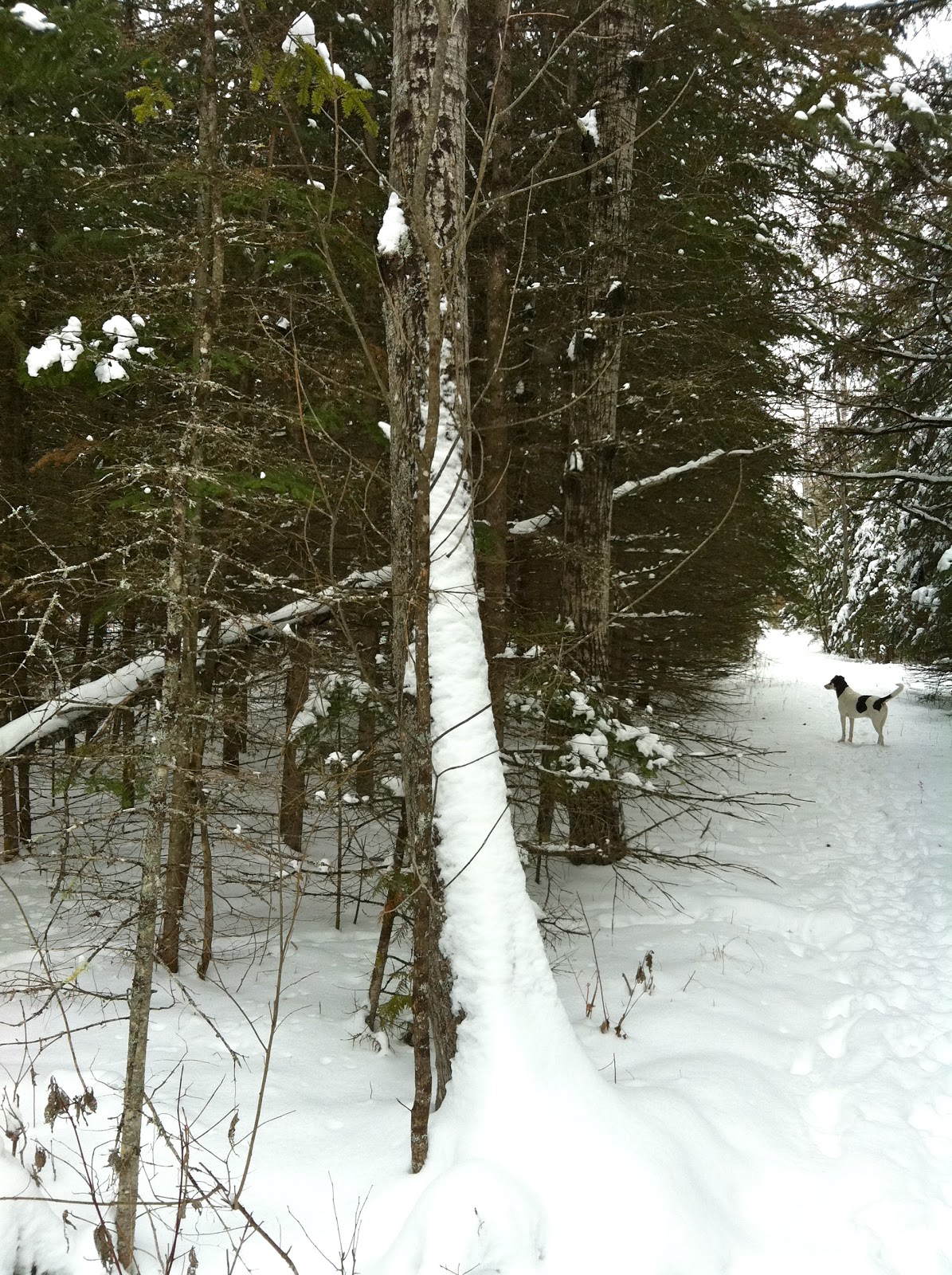
P.S. Snow came down last night and branches bend heavy, blocking the path. On the highway, we met men hunting for coyotes from their parked truck. The dogs are doing the work and satellite tracking devices show their progression, while Rocky goes mad over this intrusion and unusual fuss.
The air is still with snowflakes. From here where winter has finally arrived we wish you again happy, joyful holidays. May all good coyotes be safe, or land safely onto coyote paradise.
yesterday
today


what's with all that barking?

Wednesday, 5 December 2012

December 5, Barren trees


Ive seen that tree many years earlier and it was a most beautiful oak tree, with its large crown. At that time I did not think to paint it. What is in filling out the space with a splodge of green like others do? What is in Nature separated by large spaces, is compressed into a cramped space and overfills and oversatiates the eye, creating an unfavorable and disquieting effect on the viewer. Yet it was the lightning that came from the ether which achieved this feat of creating the space for me to paint the tree, but ... I finished by only painting the distance.

These are the painter Caspar David Friederich's words and they refer to the portrait of a tree which, after having been hit by lightening, had lost all its leaves and remained the barren, majestic ruin of its former glory. I used to study this German painter's work many years ago, he occupies an important place in my book on melancholia. Cristi sent me this quotation a few days ago, and I had an experience of shock at the sudden reminder of what I used to enjoy so much and am not able to any longer.

The figure of the barren tree is most appropriate to my present condition, and I take that as a good omen. While on my daily walk this morning, I decided to open a new theme in my photo documents, that of barren trees. Those belonging to fall into winter, most often waiting for the next spring to be revived, but also, sometimes, dead. Upon returning home with a few new takes of such trees, and opening this new file, I went through my last year's photographs and discovered, to my wonder, that I have tens and tens of such subjects. It seems I have been interested in lonely barren trees all along.
     
Just like Friedrich remarks, the barren tree allows for space to become evident. Whether the painter achieves his purpose, of painting this space, between branches for instance, and their volume in space, is of lesser importance. He did succeed in seizing the distance between the tree and himself. Otherwise put, maybe, the loneliness of the painter himself, face to face with the tree which we always perceive as lonely when it is barren.

When I had just moved in this house and had just begun our walks along the trail, I used to pass every day by a wonderful old tree, so old and long dead that it had lost all its bark and appeared naked beyond remedy. I had also recently learned that dead trees are most useful for many such critters like the woodpecker, and should not all be taken down. Our own land is filled with dead trees, and they will certainly remain there until returned in decay to the ground. Yet this old, naked tree, I learned to greet every day as I passed by like you greet a neighbor you know from afar but do not talk to. In the absolute solitude of my walks, He reassured me. Until, one day, new owners moved in, and shortly after the old trunk disappeared. I was inexplicably saddened. But what should I have expected for Him?

Not long ago we decided to replace the carpet in so many rooms of the house with hardwood floors. The choice of wood was a most interesting matter. Colin likes pine, and I, for some reason, like the ash, if only for its beautiful name. There was another pretty name in the draw, hickory. We finally decided for both pine and ash, and the work will start next week. It is an opportunity to turn yet again the house upside down, get rid of many things which should have been discarded, yet have found a hiding place and go unnoticed here. For a few nights, between sleep and wakefulness, I wondered what this enterprise was about. It is a wonderful thing, to be sure, to lay wooden floors in the rooms, and let that smell of the Forest take hold of the house. It is also a good thing to imagine that those many ash trees, killed by the ash beetle, will find a new, if artificial life, under Rocky and Alice's clicky and wishy paws. The good neighbor who will do the work assured me that the wood comes from the woods around here, and I took it as the sign of another, lesser known, attachment to the immediately surrounding landscape.


I have said, at the beginning of this note, that the barren tree was a figure of what the painter needs, to understand, or seize, true distance. That which is Barren, in Friedrich's sense, lets the space breathe in between the branches, lets the wind fashion, little by little, nakedness, to the point where it becomes sculpture. That which lets the sky, the earth show their magnitude. All which without the barren trees remains overwhelming, impossible to grasp.


Wednesday, 21 November 2012

November 21, Another kind of love


ancient sun
When we got the FaceTime connection my piano teacher appeared like a magician's illusion and took me by surprise. Her black hair quickly wrapped in a chignon, a gray vest of asymmetric collar kept in place by an oversized button, red. Thin silver rimmed glasses next to which the earphone cables looked like old fashioned eye-ware chains. Behind her, on the piano, piles of books. Yellow walls covered in prints, a lovely small room where everything seemed within reach.
It felt like we were sharing a room, closely. The sentiment perdured even as we had to fiddle with equipment so that she may see my hands and, thankfully, correct my physical approach of the instrument.

I believe the most fortunate of students are those who had the chance to be taught by people they adored. Forget the 10000 hours of practice as the road to fame and riches. I choose my words knowingly, for this has been one of the most enviable chances I was granted. To be taught, especially when young, by people I adored. Foreign languages, painting, Latin. At the university, a few professors whose knowledge I admired, if from far. Now, miraculously, my piano teacher. I say miraculously because one does not expect to experience again such emotions as are the privilege of childhood and young age.

Why is it important that one be in the throws of love in the presence of one's teacher? I am sure the answer presents itself readily. There are teachers who hand out, just like handouts, some form of knowledge, that which we call today information. And there are those rare encounters where the teacher entrusts her or his pupils with secrets more precious than knowledge. The secret is, again, out in the open. And yet, not for everybody to grasp. Knowledge without affect, without some measure of tenderness, admiration, love, which teacher and pupil alike may share, has no value.

Curiously, what I remember most vividly about the first three teachers I have named is their hands. I must have spent a lot of time watching them. Seventy year old, sixty- and thirty-something old hands. The age did not seem to matter. All such beautifully expressive hands; the first two, I imagined then, because of spending so much time writing; the third, because of drawing. The manner in which they held the pencil - they used mechanical, metal pencils to write in those days - witnessed, in my mind, to the wealth of their knowledge. As for drawing, nothing could equal the elegance of her holding le charbon, while doing esquisses.

I of course also adored my mother's hands. For wholly different reasons: do hair,  caress, make gifts, embrace. Her marvelous lips seemed to kiss even when smiling.

It is a common misconception that teaching has something to do with transference. Students would transfer some of the feelings they hold for they parents upon their teachers. I hope this is a misconception only, for my experience would then indicate that students either love their parents very little, or hate them a great deal. If this were true, then I would have had to put up with a lot of misdirected affect. For my own salvation, I prefer to think that the admiration, or rather adoration, as I like to call it, of the teacher, has to do with love of a different kind. Love for what the teachers know lovingly; or, we love them, because they tell us about the love they hold for the object of their teaching. We come together in the hope that we, too, will get to experience that feeling. Otherwise, what good would have been my love affair with Latin, a language which I never used otherwise than to hold in my heart?

My piano teacher has, of course, beautifully expressive hands. Their beauty only revealed to those fortunate enough to take lessons with her, and see her play. For such is the secret of this kind of beauty. Not apparent to whomever, whenever, but immediately obvious to she who would like to join in that kind of knowledge. Again, the word is not appropriate. These hands know, indeed, marvelous things, which came to them down the river of time. They repeat gestures which may have been deployed by somebody hundreds of years ago. The words we use today, hardly generous in describing the miracle of communication with those who came before us: transmission we say, as if speaking about a radio cast. I like to think of that communication, rather, as something akin to our relationship to the sun.

Be that as it may, and even if we were to use the word transmission, I am unendingly thankful to receive such gifts as those devised by Bartok, with whom we consort through the graceful teachings of my long distance medium and teacher; or by Schubert, and the wonder of these other, all knowing, superb old hands: